
Occupational medicine
Respiratory protection
Respiratory protection protects employees from inhaling harmful substances such as dusts, smoke, gases, vapours or pathogens. It ranges from particle-filtering half masks (FFP) to self-contained breathing apparatus.
4 frequently asked questions · sources at the end of the article
What is it about?
A distinction is made between filtering devices (which filter the ambient air) and isolating devices (which supply breathing air independently of the surroundings, e.g. the compressed-air breathing apparatus used by fire services). FFP masks are divided into classes FFP1 to FFP3.
Origin and purpose
In the STOP principle, respiratory protection is a personal measure and is used when substitution, technical and organisational measures are not sufficient.
Legal basis
- Verordnung über die Verhütung von Unfällen und Berufskrankheiten (VUV), SR 832.30 (Accident Prevention Ordinance) – fedlex.admin.ch, Art. 5 (personal protective equipment)
- Bundesgesetz über die Unfallversicherung (UVG), SR 832.20 (Accident Insurance Act) – fedlex.admin.ch, Art. 82
- Suva – respirator masks against dusts / fact sheets on respiratory protection
- Feuerwehr Koordination Schweiz (FKS) – respiratory protection regulations
What the law requires
The employer must provide suitable PPE and ensure that it is used as intended (Art. 5 of the Accident Prevention Ordinance (VUV)). This includes ensuring that the mask fits, that employees are instructed and that the equipment is maintained.
What makes sense in practice
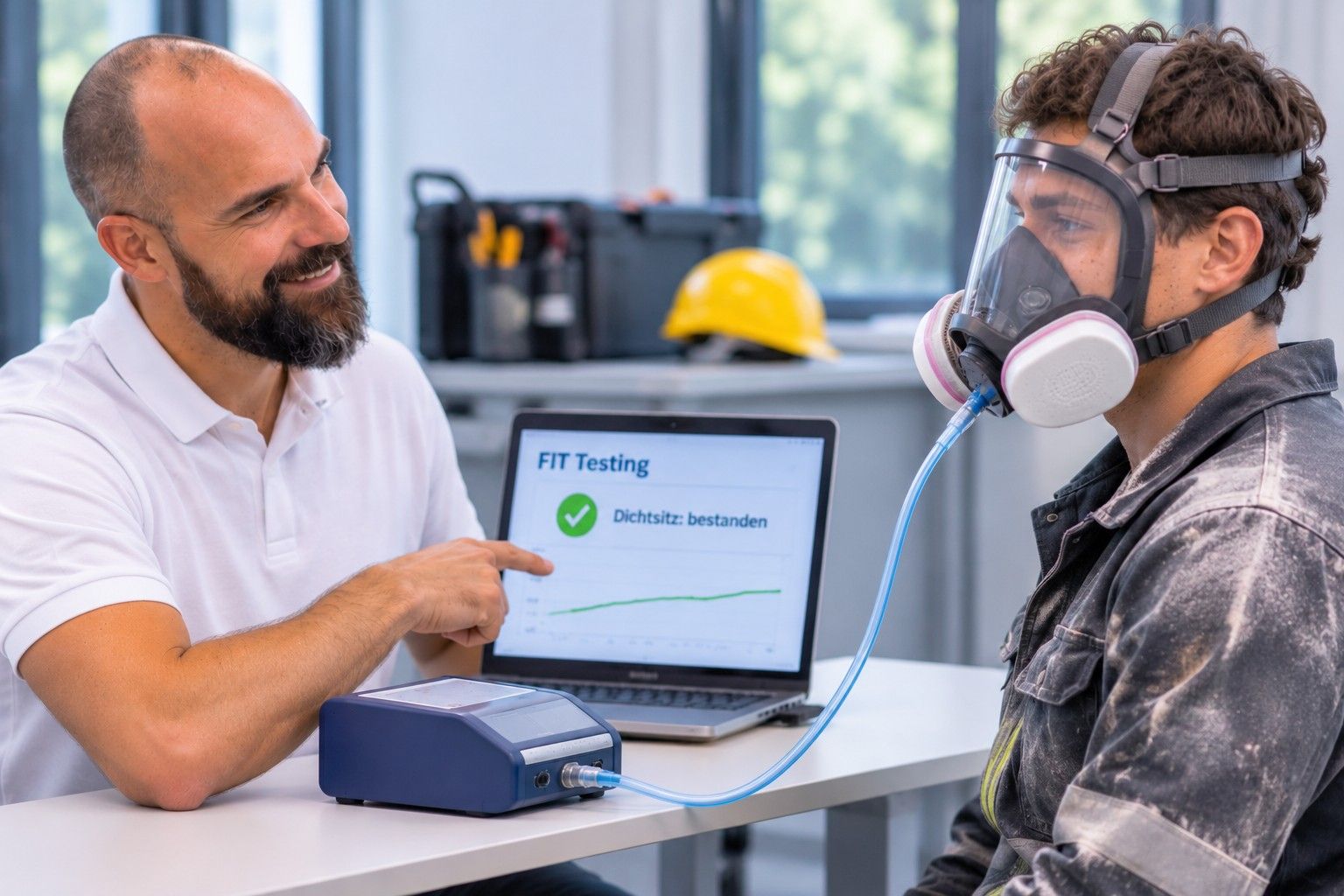
Tight-fitting masks only work if they fit well, which is why fit testing is advisable. Respiratory protection puts strain on breathing and circulation; for heavy respiratory protection, a medical fitness assessment is indicated. A beard in the sealing area prevents a tight seal.
Who is this relevant for?
- Construction (quartz dust, asbestos)
- Industry, chemicals, laboratories
- Healthcare (infection control)
- Fire services
- Agriculture
Frequently asked questions about Respiratory protection
What do FFP1, FFP2 and FFP3 mean?
Protection levels for particle-filtering half masks with increasing filtering performance.
Do I need a medical examination for respiratory protection?
For demanding respiratory protection (e.g. compressed-air breathing apparatus, long wearing times), a medical fitness assessment is indicated; for fire services it is mandatory.
What is fit testing?
Testing the seal of a mask on the individual person.
Can you wear a mask with a beard?
A beard in the sealing area prevents a tight seal, so the protective effect is then not guaranteed.