
Workplace safety and Swiss regulations
Personal protective equipment
Personal protective equipment (PPE) protects employees from hazards that cannot be eliminated by technical or organisational measures, such as helmets, safety goggles, hearing protection, respiratory protection, gloves, safety shoes or fall protection.
4 frequently asked questions · sources at the end of the article
What is it about?
In the STOP principle, PPE is the last measure. It is only effective if it fits and is worn and maintained correctly.
Origin and purpose
PPE complements collective protective measures but does not replace them.
Legal basis
- Ordinance on the Prevention of Accidents and Occupational Diseases (VUV), SR 832.30 – fedlex.admin.ch, Art. 5 and 11
- Ordinance on the Safety of Personal Protective Equipment (PSAV), SR 930.115
What the law requires
The employer must provide PPE if accident and health hazards cannot be ruled out by other measures, and must bear the costs (Art. 5 VUV). Employees must use it (Art. 11 VUV).
What makes sense in practice
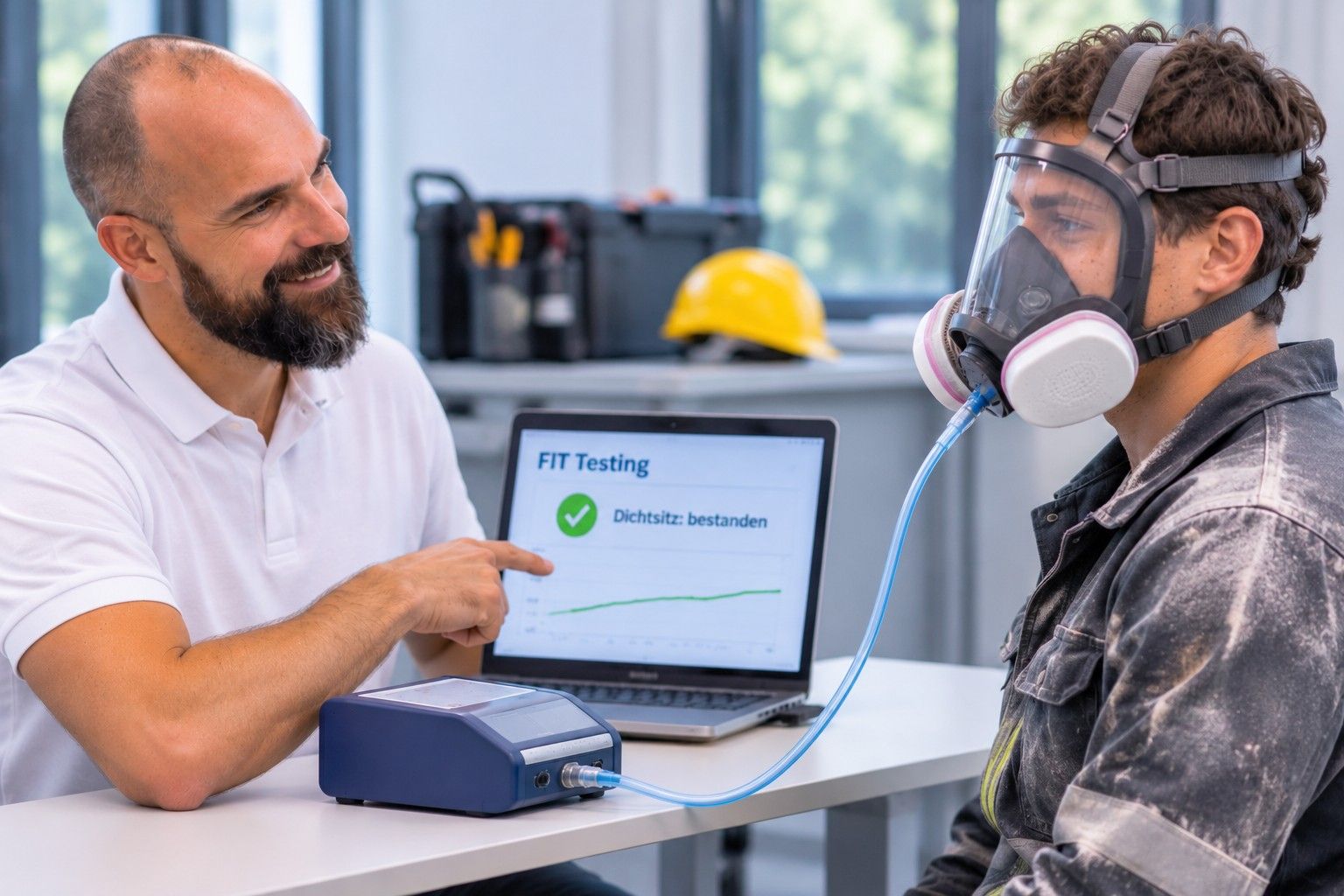
Select suitable products, instruct employees, check that PPE is worn, and organise maintenance and replacement. For respiratory protection, fit testing and, if necessary, an aptitude examination.
Who is this relevant for?
- Construction, industry, laboratories, healthcare, agriculture, fire services
Frequently asked questions about Personal protective equipment
Who pays for PPE?
The employer.
Do employees have to wear PPE?
Yes, they are obliged to do so.
Why is PPE the last measure?
Because it only works if it is worn correctly and consistently.
How do I check whether a mask fits?
With fit testing.